Apologies to Ranganathan.

Say you have a Git repository you want to publish, and you’ve set up a Gitweb for it at http://git.example.com/?p=myrepo.git;a=summary.  So far, so good: others can browse your commits and download packages and tarballs.  Suppose you’ve also configured git-daemon(1) to publish the repo using the Git protocol.  Great!  Now suppose you’ve told the world to go to http://git.example.com. The world looks at what you have wrought, and then asks: How can we clone your repository?

Even assuming that you’ve used the default options in your git-daemon configuration, the Git clone URL could be any of the following depending on where your OS distribution’s packagers decided to put things:

  • git://git.example.com/myrepo
  • git://git.example.com/myrepo.git
  • git://git.example.com/git/myrepo
  • git:/git.example.com/git/myrepo.git
  • and there are even more possibilities if you did tweak the config

The rub is that Gitweb doesn’t know and can’t know until you tell it.  If you don’t tell it, somebody who wants to clone your repo and who is looking at the Gitweb page can only guess.  If they guess wrong a few times, they may give up.

Fortunately, the solution is easy: to make the Git clone URL display in your Gitweb, go to the repository’s base directory and create a new file called cloneurl and enter the correct clone URL(s), one per line. While you’re at it, make sure that the description file is accurate as well.
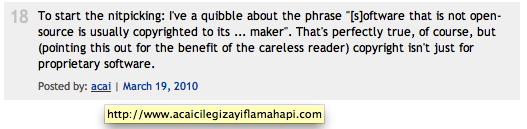
I saw a particularly annoying form of comment spam in Dorothea Salo’s excellent summary of various kinds of open information:

screenshot of plagiaristic comment spam

The author link points to the site of what appears to be a Turkish dietary supplement vendor.  Just a bit off-topic, unless this is somehow a subtle way of announcing that they’re releasing their supplement under an open recipe license.  What really steams me: the text was copied from one of my comments on the post.

Failing grade for plagiarism.

On Wednesday, two committees of the Florida state legislature recommended removing funding for the Florida State Aid to Public Libraries program. This is the second time in as many years that this has happened. To compound the problem, the elimination of state aid would also mean that Florida libraries would no longer qualify for some forms of federal aid.

While a handful of library systems in Florida are independent taxing districts and could (painfully) weather this, elimination of state aid would mean that a lot of rural and city libraries would have to close branches, cut hours, and lay off library staff. Many rural libraries are already operating on shoestrings.

Do you live in Florida? Call your state representative and senator today and ask them to vote to continue funding for state aid to Florida libraries. Also, please ask them to stop this proposal from becoming an annual tradition. No brinkmanship with our libraries, please!

Update 2010-04-28: State aid has been restored! [PDF link] Can we not play this game again next year?